The Space Intelligence infrastructure.
Anticipating the risks of the space environment and turning them into operational decisions. Serving satellite operators today. Serving crewed missions tomorrow.
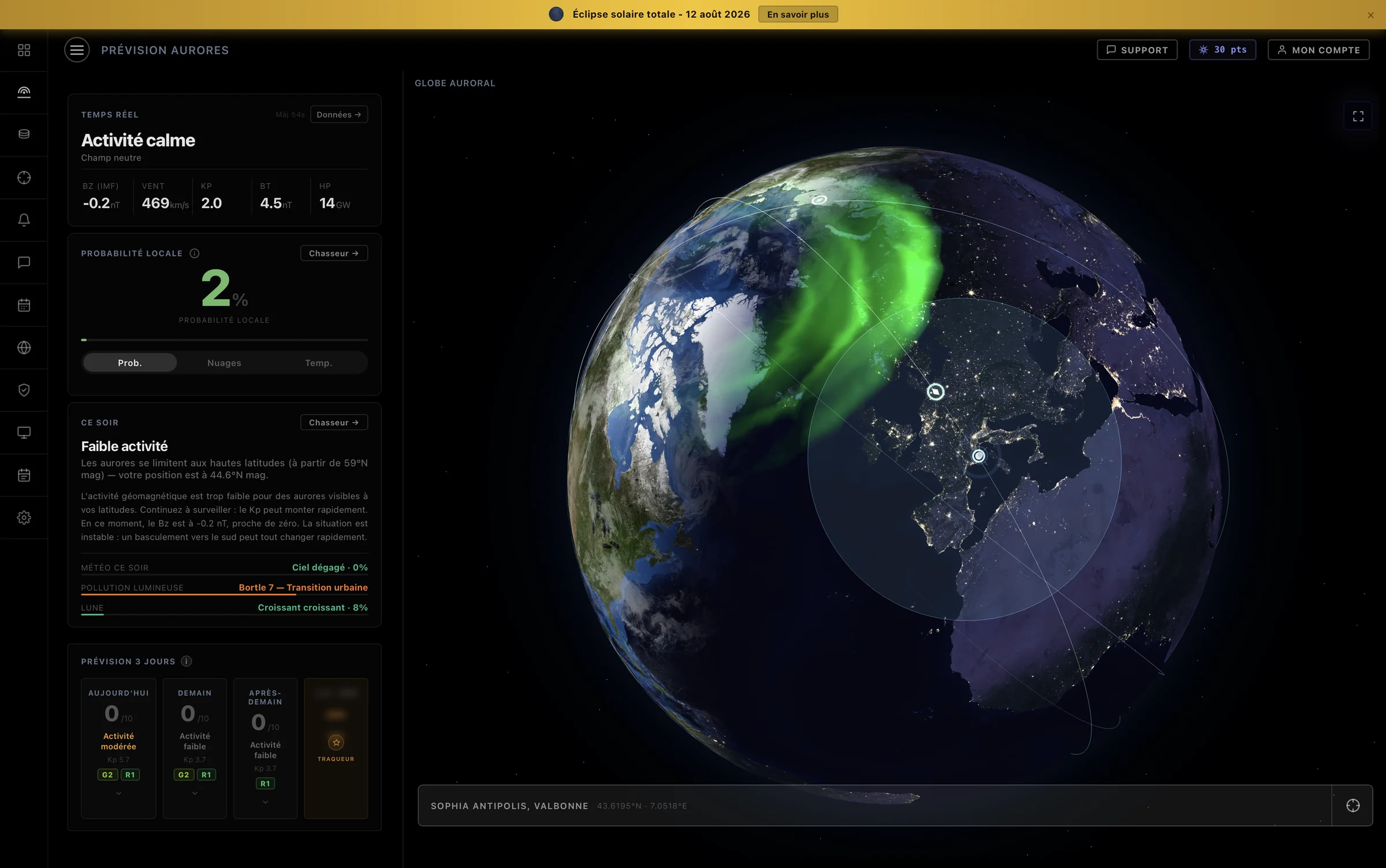
We turn Space Weather into an operational decision tool.
They support us





Featured in the press
Space Weather bulletins exist. Decision tools for operators don't.
A solar storm can cost you a satellite.
- Electronic anomalies × 10 to × 20
- Altitude loss
- Solar panel degradation
- Onboard control compromised
The NewSpace boom multiplies the number of satellites in orbit while their platforms get smaller. Performance goes up, resilience to solar perturbations goes down. A single energetic particle peak can multiply electronic anomalies by a factor of 10 to 20, degrade solar panels, cause altitude loss, or compromise onboard control. Today, one storm is enough to interrupt a mission.
Generic bulletins protect no satellite.
- Fragmented data
- No link with your satellite
- No actionable recommendation
- Always-late reactions
Public Space Weather bulletins have existed for decades. They describe solar activity in generic terms, but they fail to answer the one question that matters to an operator: what will happen to my satellite, when, and what should I do about it? Without a direct link between solar activity and each satellite in the fleet, operational teams are forced to react — almost always too late.
Fewer anomalies. Protected missions. Extended operational life.
Every PULSAR alert is designed to be read and acted on by an operator. Within seconds, they know which satellites are exposed, when, and what procedure to trigger.
- Per-satellite alertsRisk assessment contextualised by NORAD ID, orbit and mission profile.
- Action recommendationsSafe mode, maneuver hold, panel re-orientation — tailored to each satellite.
- Analysis bulletinsContextual reading of events, written by our scientific team.
Discover
the platform
Our platform combines a real-time dashboard, an API, and analysis bulletins written by our scientific team. For every satellite tracked, it delivers contextualized alerts and recommendations that your mission control center can execute directly.
Book
a demo
Thirty minutes with our team to discuss your missions and orbits. We walk you through the platform in real conditions, and you leave with a concrete assessment of the solar risk applied to your fleet.
Our news
Bpifrance Deeptech label, ESA BIC South France incubation, platform performance under major solar storms. Follow the milestones of a company building the protection infrastructure for orbital systems.
Let's talk about your missions.
Satellite operator, space agency, investor or industrial partner — tell us what you're trying to solve.